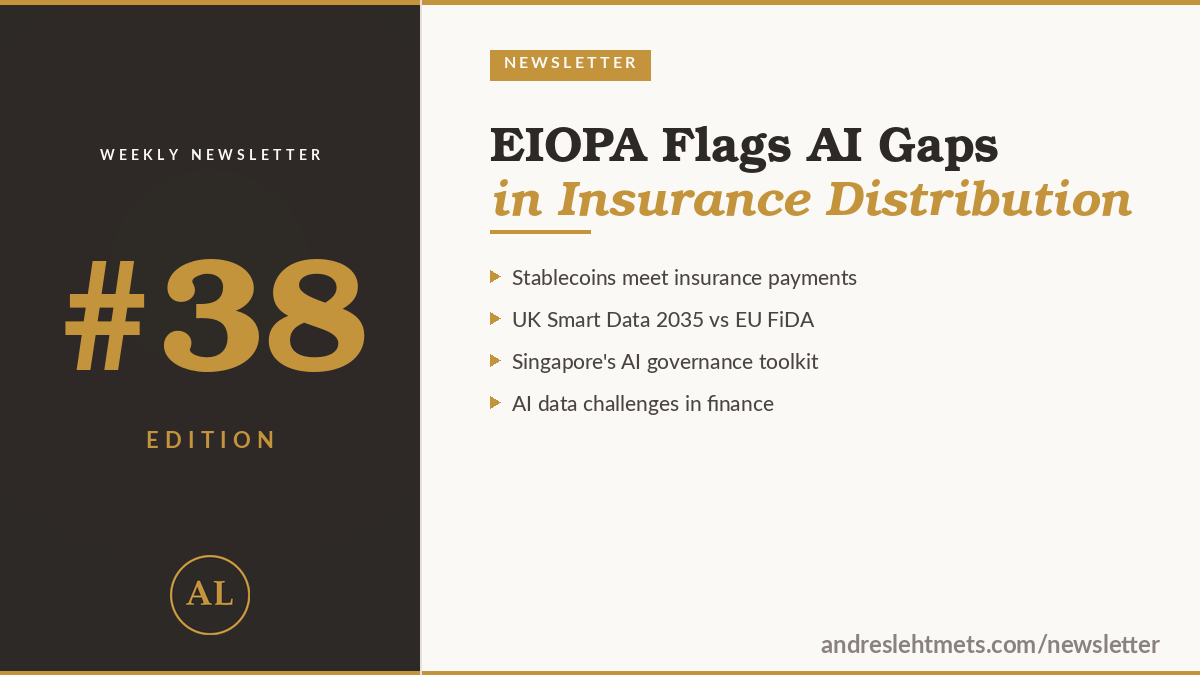
#38: EIOPA flags AI gaps in insurance distribution. Is the IDD keeping up?
There is quite a lot happening in financial innovation and regulation right now.
From my side, I have recently spent a good amount of time catching up on the Retail Investment Strategy (RIS) and its current state of negotiations, including from a digitalisation perspective, which is of course closest to my heart.
There are some encouraging developments, particularly around online disclosures. But there are also areas that may require significant business changes. Having said that, there is again a lot of uncertainty around the file at the last minute. Let us see how it develops.
I will keep you posted.
In the meantime, here is what else caught my attention this week.
If you find this newsletter useful, forward it to a colleague who works in financial regulation or digital finance. It takes 10 seconds and helps this newsletter reach the people who need it.
EIOPA's Third IDD Report: What It Tells Us About AI in Insurance Distribution
EIOPA published its Third Report on the application of the Insurance Distribution Directive (IDD). It covers market structure, cross-border activity, advice quality, sustainability disclosures and inducements. But the section on digitalisation and AI is where things get most interesting.
The headline finding: digital distribution in insurance is progressing slowly. Digital tools are mostly used for internal efficiency, not customer-facing distribution. Where digitalisation does reach the customer, it concentrates on simple products like motor or travel insurance. Complex products, especially life insurance and IBIPs, still rely heavily on face-to-face advice.
On AI, adoption is expanding but remains uneven across EU markets. According to EIOPA's recent GenAI survey, 65% of participating insurers reported using generative AI, but most use cases (64%) are back-office. For customer-facing applications, 75% are still at the proof-of-concept stage.
The part that matters most: the IDD is technology-neutral, which was seen as a strength. But EIOPA now signals clearly that this neutrality creates gaps when it comes to AI-driven distribution. Chatbots and automated advice tools can effectively replace human advisors, yet Article 10 of the IDD requires distributors to possess adequate knowledge, skills and good repute. AI tools cannot fulfil this requirement as non-human entities. This raises unresolved questions around accountability and liability.
Furthermore, the upcoming Digital Fairness Act may address some of the topics flagged in this report, including finfluencers and personalised pricing.
I wrote a detailed analysis on my blog. Read more here.
Stablecoins Meet Insurance: Aon's Proof of Concept
Insurance moves $7 trillion in premiums globally. Most of it still settles through correspondent banking chains built decades ago. Aon just tested something different.
The broker completed the first known stablecoin premium payment among major global brokers. A proof of concept using USDC on Ethereum and PYUSD on Solana, in partnership with Coinbase and Paxos.
This is not a crypto story. This is an insurance payments story. The insurance value chain runs on premium flows: client to broker, broker to insurer, insurer to reinsurer, and back again through claims. At every step, money passes through intermediaries and correspondent banks. Cross-border settlements take days.
Stablecoin rails offer near-instant settlement, 24/7 availability and lower cost. What made this possible was regulatory clarity. In the US, the GENIUS Act (2025) created the first federal framework for payment stablecoins. In the EU, MiCAR has been in force since June 2024. Global reinsurance premiums alone exceeded $394 billion in 2024. That is a lot of capital moving slowly through old pipes.
I expect this is an area where we will see real change soon. Read more here.
Singapore Raises the Bar on AI Governance in Financial Services
The Monetary Authority of Singapore (MAS) published an AI Risk Management Toolkit built with 24 financial institutions. Not theoretical principles. An actual operationalisation handbook with real case studies, covering traditional AI, generative AI and agentic AI. The latter is an area where most frameworks are still catching up, and it is good to see a regulator and industry tackling it together.
As a former regulator and policymaker, I find the collaborative model particularly notable. 24 firms co-developed this with MAS, and a permanent industry workgroup under BuildFin.ai will keep updating it. Regulation as a living process.
This is the kind of practical, industry-embedded approach to AI governance that more regulators should consider. If you are working through AI governance in financial services, this toolkit is worth reading closely.
UK Smart Data 2035 vs EU FiDA: A Growing Gap
The UK just published Smart Data 2035, its national smart data strategy. Meanwhile, in the EU, we cannot agree on FiDA.
The potential for open finance is extensive. Personalised credit scoring, AI-powered financial resilience tools, secure digital identity, SME growth analytics. Insurance. Pensions. Investments. All working together, not in isolation. The FCA's Open Finance Sprint Report lays out concrete priority areas. The Data (Use and Access) Act 2025 gives the UK government real powers to implement smart data schemes.
And in the EU? The Financial Data Access Regulation (FiDA) has stalled. Not because of the Commission, which has done excellent work protecting the proposal. The call is for member state governments and stakeholders to step up.
I say this as someone who has worked inside EU regulatory institutions: we are excellent at writing frameworks. We are less excellent at shipping them or taking bold decisions. Open finance is not a nice-to-have. It is infrastructure. The Savings and Investment Union (SIU) and the competitiveness and growth agenda cannot succeed without it.
The UK is building. We are still debating.
Quick Links
BIS: Open finance is reshaping financial systems in real time. A new BIS paper shows how customer-permissioned data sharing is breaking through decades-old data silos, reducing information asymmetries and driving new venture capital investment. This reinforces why the EU needs to deliver on FiDA. Without it, it will be very difficult to deliver on our growth, competitiveness and Savings and Investment Union ambitions. Open finance is not just a technology question. It is a competition, financial inclusion and increasingly a geopolitical question. Read more here.
BIS: The biggest barrier to AI in finance is the data, not the models. Another BIS paper highlights three persistent challenges: data quality (incomplete or biased data feeding AI produces poor outputs, and generative AI makes this worse), data privacy and security (the tension between feeding models and protecting customers), and third-party concentration (systemic dependency on a handful of infrastructure providers). The paper calls on financial authorities to provide clearer supervisory expectations on AI-related data usage. Not more rules, but more clarity on what good practice looks like. Read more here.
Number of the Week
75%
That is the share of customer-facing generative AI applications in European insurance that are still at the proof-of-concept stage, according to EIOPA. The technology is moving fast, but deployment in insurance distribution remains cautious. Will 2026 be the year insurers move from experimentation to implementation?
Get in Touch
Subscribe to my newsletter here See how I can help you here Follow me on LinkedIn
I´m now selectively considering sponsorship partnerships for this newsletter. If reaching 4,600+ decision-makers in financial regulation and innovation is interesting to you, let me know.
Member discussion