£43 Billion: What the UK's Open Banking Numbers Mean for the Open Finance Debate
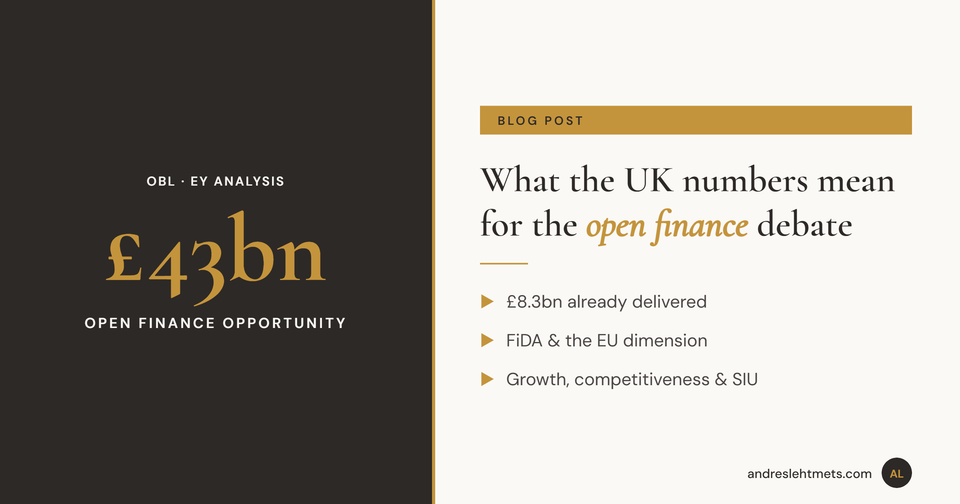
New analysis commissioned by Open Banking Limited (OBL) and completed by EY puts a number on what many of us have suspected: open banking is not just a technology initiative. It is an economic growth engine.
At full maturity, open banking could deliver up to £43 billion per year to the UK economy. The modelling is grounded in specific use cases across payments, savings, lending and cloud accounting. Open banking has already delivered an estimated £8.3 billion in cumulative benefit to date, with annual benefits projected to reach £7.4 billion within five years.
For consumers, that means better financial management and fairer products (£2.5 billion annual GDP uplift). For SMEs, less administration and lower transaction costs (£2.3 billion). With 17.5 million live user connections and 145 authorised providers, this is real infrastructure generating measurable value.
The analysis is UK-specific, but the use cases are not. Payments, savings, lending, insurance: these exist in every financial system. The economic logic is portable. When consumers and businesses can share financial data securely with trusted third parties, costs fall and capital flows more efficiently.
From a broader perspective, this economic evidence is important to keep in mind here in the EU as we discuss growth, competitiveness, the Savings and Investments Union (SIU), and the Financial Data Access Regulation (FiDA). These debates sometimes run in parallel without enough cross-referencing. The UK numbers help connect them. I have argued for a long time that they are all linked.
FiDA extends data-sharing rights beyond banking to insurance, pensions and investments. Open finance tools help consumers understand their coverage gaps, compare products across providers and make informed decisions. When financial data is portable, people can act on it. When it sits locked in silos, they cannot.
The timing is useful. FiDA negotiations continue in Brussels and the competitiveness discussion is intensifying. The question for Europe is not whether open finance creates value. The UK has now measured it. The question is how quickly we want to capture it.


Member discussion