Reframing Risk: What Vanguard's Research Means for the Savings and Investment Union
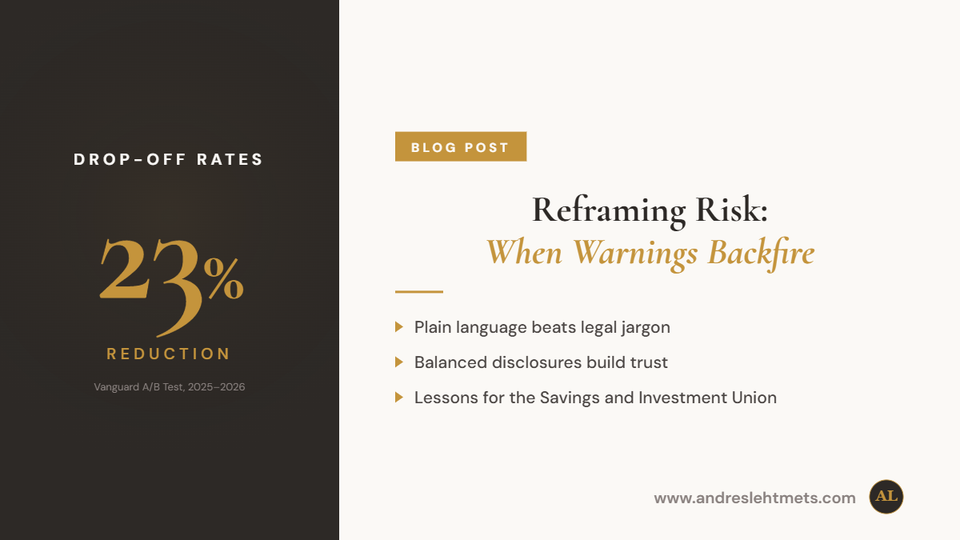
Vanguard just proved that the way we warn investors about risk is making them too afraid to invest.
In a study of 2,220 people, they rewrote the standard risk disclosures that every investment firm uses, the ones regulators require, the ones we all know by heart. "Capital at risk." "Past performance is not a reliable indicator of future returns."
The result: a 23% reduction in customer drop-off rates. Not from removing warnings. From rewriting them to be human.
This is not a UX story. This is a regulatory design story. And it matters a lot right now.
What Vanguard actually tested
The research ran in four phases: unmoderated user testing, qualitative interviews with new investors, a nationally representative survey of 2,220 participants, and finally a real-world A/B test in their ISA onboarding journey.
The control version used the standard language we all recognise: "Past performance is not a reliable indicator of future returns. The value of investments, and the income from them, may fall or rise and you might get back less than invested."
The alternative version said the same things differently. It opened with "As you start your journey with us, remember" and then framed investing as a long-term discipline: investments typically drive greater returns over five years compared to cash, market movements are normal, and staying invested gives you time to ride ups and downs.
Same regulatory substance. Completely different emotional response.
The numbers
Across the full sample, the rewritten version scored significantly higher on every measure that matters:
54% said it made them more confident to invest, compared to 44% for the traditional wording. 51% said it made them more likely to invest, versus 40%. And 84% understood that investing is for long-term savings goals, compared to 73%.
Among women, the confidence gap was even more striking: 62% versus 46%. Among 18 to 34 year olds: 71% versus 58%.
But the headline finding came from the real-world A/B test. When Vanguard deployed the new wording in their actual ISA onboarding flow, drop-off rates fell by 23%. That is not a survey response. That is real behaviour, real money, real people completing a journey they would otherwise have abandoned.
Four things the research tells us
First, language matters more than we think. The word "capital" confused people. Participants described the traditional warnings as "abrupt" and "fear-inducing." One said it made them want to "adopt the fetal position." When you write disclosures in plain, human language, people actually read them and understand what they mean.
Second, balance builds trust. Traditional warnings only talk about what you could lose. When the rewritten version acknowledged both risks and potential rewards, participants described it as feeling like "a partnership" rather than a threat. This is not about downplaying risk. It is about presenting the full picture.
Third, placement changes everything. 86% of investors said they wanted risk information earlier in the journey, not buried in the final confirmation screen. Vanguard tested moving different disclosures to different stages and found that contextual placement, the right information at the right moment, dramatically improved comprehension and confidence.
Fourth, brevity is not always best. People did not mind longer text if it was informative and educational. The fuller disclosure consistently outperformed the shorter one. As one participant put it: "It contains more detail and teaches you stuff."
Why this matters for Europe right now
We are in the middle of building the Savings and Investment Union. The political agreement on the Retail Investment Strategy is in place, with Level 2 and Level 3 work continuing. The PEPP review and the IORP review are on the horizon. ESMA is actively rethinking how to simplify consumer journeys across investment products.
Much of what Vanguard found, firms can act on today. Look at the language you use. Test whether your disclosures inform or intimidate. Move information to where it actually helps people make decisions.
But there is also a clear message for regulators and supervisors. The Vanguard evidence suggests we should think beyond individual risk warnings and consider the overall disclosure architecture. Making layered disclosure a default design principle, placing the right information at the right moment in the product journey, could make a meaningful difference to participation and confidence.
The traditional approach treats disclosure as a legal safeguard: put the warning in, box ticked, consumer protected. Vanguard's research challenges that assumption directly. A warning that nobody understands protects nobody. A disclosure that educates and informs builds the kind of consumer confidence that actually supports long-term financial wellbeing.
The bigger question
The Savings and Investment Union will not succeed through product innovation alone. It needs people to participate. And participation requires confidence.
If the evidence shows that the way we communicate risk actively discourages the people we are trying to protect, then the way we communicate risk needs to change. Not to lower standards, but to meet them properly.
Good consumer protection is not just about what we disclose. It is about whether anyone actually understands it.
Full Vanguard paper is available here.





Member discussion